The Best Shopify App for Social Proof (2026)
· updated
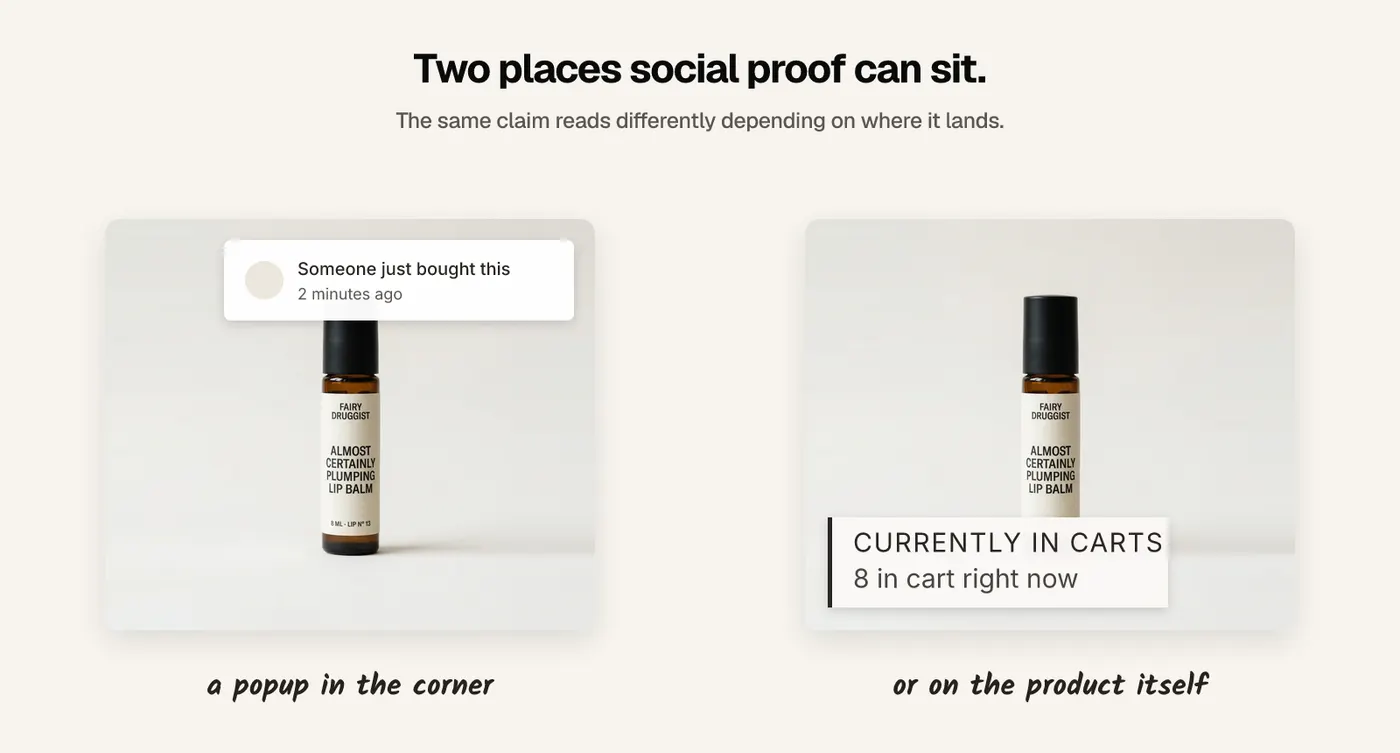
There is no single best one. For the longest track record, Fomo. For the highest rating, ProveSource. For the lowest price, Sold Count. For proof on the product image instead of in a corner popup, mine. Disclosure, because it changes how you should read this: I build Sold So Many, one of the five apps below. This is my blog. I have tried to make the comparison honest enough to be useful anyway, which mostly means saying out loud where my own app is the weaker choice. It has the fewest reviews on this list by a wide margin, and that is a real reason to hesitate.
How I compared these
Four things, all checkable without installing anything:
- Where the proof appears. A corner popup, inline on the product page, on the product image, on collection grid cards. This is the biggest practical difference between these apps and the one most roundups skip.
- Price floor, and whether there is a free tier.
- Track record. Rating and review count on the App Store. Not a quality measure, but the only independent signal available.
- Whether the numbers are real. Some apps in this category will generate a plausible figure for you. That is a category-defining difference and it deserves to be asked about. All figures below were read from the live App Store listings on 23 August 2026. They move, so check before you buy.
The comparison
| App | Rating | Reviews | Free tier | Paid from | Where proof appears |
|---|---|---|---|---|---|
| Fomo: Social Proof Sales Popup | 4.5 | 125 | yes | $25/mo | popup and on-page |
| ProveSource: Sales Pop Ups | 4.9 | 84 | yes | $29/mo | popup and inline on PDP |
| Nudgify Social Proof Sales Pop | 4.3 | 50 | yes | $9/mo | popup nudges |
| Sold Count: Product Sale Proof | 3.9 | 9 | free to install | $4.90/mo | inline on product page |
| Sold So Many: Social Proof | 5.0 | 3 | yes | $19/mo | product image, inline, collection grid |
Fomo, if you want the safest choice
125 reviews at 4.5 is the longest track record in this group by some distance, and for a lot of merchants that is the whole decision. Its listing describes popup and on-page messages for recent purchases, add to cart events and product page visits, plus low stock alerts, and it advertises integrations with over 100 other apps and a one to one setup call. Pick it if you want the app least likely to surprise you, or your proof needs to pull from tools outside Shopify. Skip it if $25 a month is above your floor for this, or you specifically do not want a popup.
ProveSource, if rating matters most
4.9 from 84 reviews is the best rating on this list among apps with a real sample size. Its listing covers recent orders, reviews, live visitors, low stock and add to cart popups, and it explicitly offers inline embedded proof on the product page rather than popups only. Geo targeting and multilingual settings are called out. Pick it if you want a well-regarded app with both popup and inline placement and you are comfortable at $29. Skip it if you need proof on collection pages, which is not something the listing claims.
Nudgify, if you want the cheapest real plan
$9 a month is the lowest genuine paid entry here. The listing leads on nudges: live visitors, recent sales, reviews, low stock alerts and one click discounts. 4.3 from 50 reviews is the weakest rating of the established three, which is worth weighing against the price. Pick it if budget is the binding constraint and you want breadth of nudge types. Skip it if you want the number attached to a specific product rather than storewide activity.
Sold Count, if you only want a sold count
The closest thing to a single purpose tool here. Its listing describes sold counts, a trust badge, stock and product labels on product pages, plus a slide of customers who bought. At $4.90 it is the cheapest paid plan on the list. Pick it if your entire requirement is a units sold number on a product page and you want to spend almost nothing. Skip it if the track record worries you. 3.9 from 9 reviews is the weakest signal in this group, and it has fallen over the past year rather than climbed.
Sold So Many, which is mine
I built it around a different bet: that the number belongs on the product image and the collection card, where the shopper is already looking, rather than in a corner toast they will dismiss. It shows sold counts over 24 hours, 7 or 30 days, best seller rankings, recent purchases, product views, cart activity and a live visitor counter, on product pages and collection grids. You choose which products get which label by tag, price, stock or schedule, and there are six presets and three density levels so it can be tuned from subtle to prominent. It measures its own effect against a holdout group, so the reporting says what the widget earned rather than how often it appeared. Free up to 10,000 visitors a month, then $19, $45 and $85 by traffic, with every feature on every plan. Pick it if placement is the thing you care about, or you want to know whether the proof is actually doing anything. Skip it if you want a track record. Three reviews is not evidence, and no amount of me describing my own app changes that. If you would not buy an app with three reviews, that is a defensible position and you should buy Fomo.
The question worth asking any of them
What happens when the number is zero? Some apps in this category let you set a minimum, a range, or a refresh interval that changes the figure on a timer. Those are the settings of a random number generator, not a counter. If a product has had no visitors this hour, an honest app says nothing. This matters more than any feature comparison above. Shoppers open two tabs. They come back the next day. A count that moves in a way your store cannot explain teaches them something about you that you cannot unteach, and the products where an invented number is most flattering are exactly the ones with no traffic to justify it. All five apps here work from real store data as far as their listings claim. Ask anyway, including of mine.
If you take one thing
Decide on placement before you decide on price. Popup and inline are genuinely different products that happen to share a category, and merchants who pick on price alone usually end up with a popup they later turn off.
FAQ
What is the best social proof app for Shopify? It depends on what you need. Fomo has the longest track record at 4.5 from 125 reviews, ProveSource the highest rating at 4.9 from 84, Nudgify the cheapest real plan at $9 a month, and Sold Count the lowest price overall at $4.90. Is there a free Shopify social proof app? Several have free tiers, including Fomo, ProveSource, Nudgify and Sold So Many. Free plans are normally capped by monthly visitors or notification volume. What is the difference between a social proof popup and inline social proof? A popup is a corner toast about storewide activity, usually a recent order elsewhere in your store. Inline proof sits on the product page or product image and is about the item on screen. Popups are noticed more, inline is more relevant and costs no dismissal. Do social proof apps use real data? The reputable ones do. Some apps allow a configurable minimum or range for visitor counts, which means the number is generated rather than measured. Ask before installing. Does social proof actually increase conversions? It varies by catalogue and it is worth measuring rather than assuming. It tends to help most on products with real volume and to do nothing on products without it, which is why applying one widget to every product is usually the wrong setup. Written by Mehmet Tekin, 23 August 2026. All ratings, review counts and prices read from the live Shopify App Store listings on that date. I build _Sold So Many, which is one of the five apps compared above, and I have tried to say clearly where it is the weaker pick._