How M&S, Amazon and SHEIN Do Social Proof
Somewhere on your category page, someone is deciding whether to buy. They have your photographs, your copy, your price, and one question: is this actually worth it?
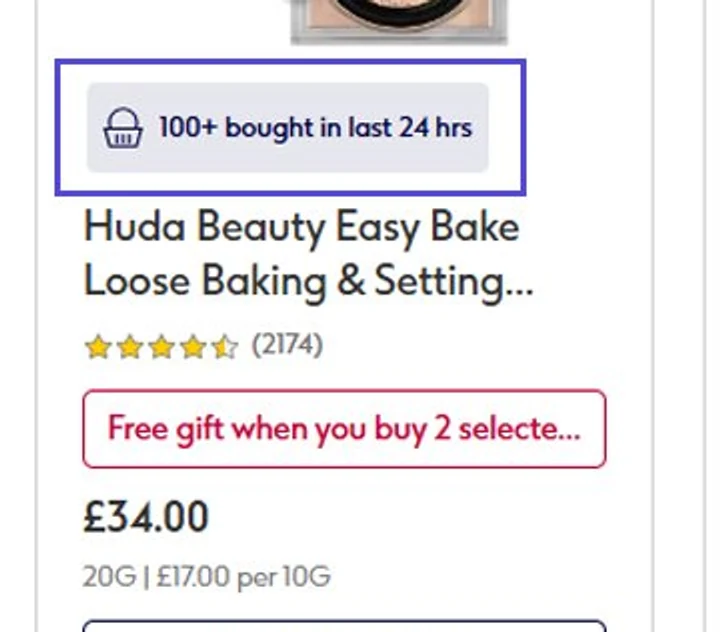
Every large retailer answers that question the same way, in type smaller than the price. Boots prints "100+ bought in last 24 hrs". Amazon prints "100+ bought in past month". SHEIN prints "10k+ sold". M&S prints "100+ people are looking at this right now". Revolve prints "IN DEMAND! Sold 100+ times in the last 48 hrs". ASOS, with no number in it at all, prints "SELLING FAST".
Six stores, six phrasings, one tactic: let other shoppers answer the question instead of answering it yourself.
In short: what the big retailers actually print
They print a claim about a population, never a story about a person, and they read it off their own orders and traffic. Amazon says "100+ bought in past month" — a hundred people, which its order table can prove — and deliberately does not say "Sarah in Edinburgh just bought these", which nobody can check. Every number is small, plain, and substantiable.
The five claims on a product page
Read the six examples side by side and they stop looking like one tactic. They are five distinct signals, and the difference between them is what each one is a count of.
| Signal | Example in the wild | What it counts |
|---|---|---|
| Count in a window | Boots "100+ bought in last 24 hrs"; Amazon "100+ bought in past month"; Revolve "Sold 100+ times in the last 48 hrs" | Orders, over a period that keeps moving |
| Cumulative count | SHEIN "10k+ sold" | Orders, since the product was listed |
| Live viewers | M&S "100+ people are looking at this right now" | People, in this moment |
| Rank | M&S "#3 BESTSELLER in Mens Tops"; SHEIN "#1 Bestseller in Lace Women Clothing" | Position within a category |
| Flag, no number | ASOS "SELLING FAST" | Nothing measurable at all |
The first four are counts. The fifth is a claim dressed as one, and it is worth noticing that the store using it is the one that has decided a number would be a liability.
Caption: Boots, on a category listing: a basket icon and a count in a 24-hour window. (Screenshot of boots.com, cropped to the claim.)
The taxonomy matters because the signals do different jobs and decay differently. A window tells you what is happening now. A lifetime total tells you the product has a history. Live viewers tell you the shop is busy around you. A rank tells you where this sits among its neighbours. Only one of those is a reason to act today.
Why a claim about a population beats a story about a person
A population claim is checkable and a personal claim is not, by construction.
"100+ bought in past month" is a statement about a set. If a regulator, a platform's policy team or a suspicious customer asks, the retailer's own order table is the answer — the number either matches or it does not, and the store controls whether it does. That is why it can be printed in 11px grey and left there for years.
"Sarah in Edinburgh just bought these trainers" is a statement about an individual. There is no table to check it against, no way for a shopper to confirm it, and no cost to inventing it. The claim is unverifiable because it is personal — which is precisely what makes it the standard move in a popup, and precisely why no serious retailer puts it on a product page.
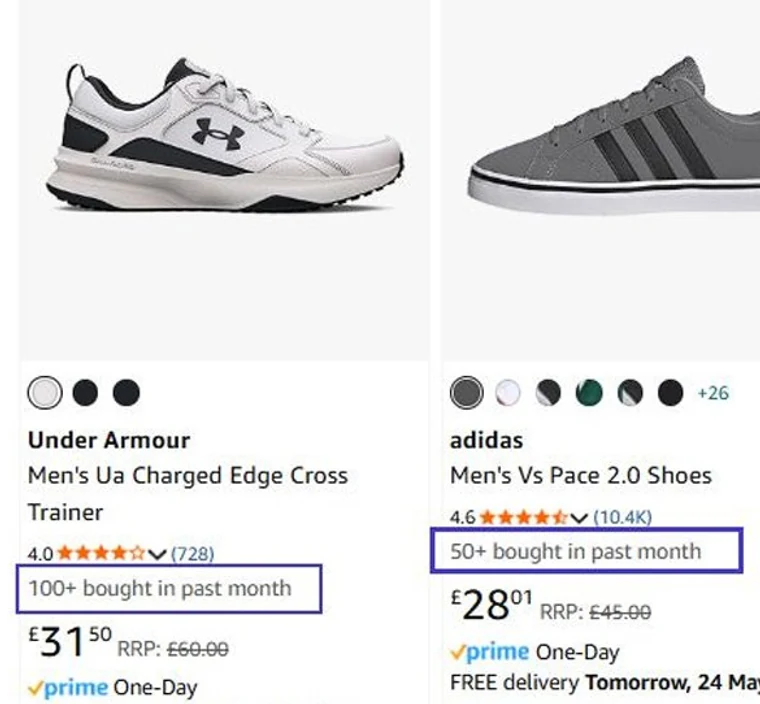
Caption: Amazon, twice in one row: "100+ bought in past month" on both listings. A count of orders, with no name, no city and no timer. (Screenshot of amazon.co.uk, cropped to the claim.)
The enterprise version of social proof is boring for a reason. Boring is what survives being asked to substantiate it.
There is a second effect, and it is the one that makes the tactic worth copying rather than admiring. A count of a population carries no story for the shopper to argue with. A story about a person invites one — who is Sarah, why does she matter to me — and it gives the shopper something to disbelieve. Six stores have converged on the same restraint, and it was not politeness that got them there.
The window is the honest part
"Last 24 hrs" decays. "10k+ sold" only grows. Both are true, and only one of them is useful today.
A count in a window is a measure of current demand, so it can fall. Quiet Tuesday, fewer than yesterday, and a store with real numbers has to live with that. This is uncomfortable and it is the whole mechanism: a number that can go down is a number that means something when it stays up.
A lifetime total has the opposite problem. SHEIN's "10k+ sold" is impressive the first time a shopper sees the product and inert every time after. It cannot distinguish a product that is selling right now from one that sold out its launch and has been coasting since. It never has to be defended, because it is never specific about when.
| Count in a window | Cumulative count | |
|---|---|---|
| Example | "100+ bought in last 24 hrs" | "10k+ sold" |
| Moves | Up and down with demand | Up only |
| Answers | Is this moving now? | Has this ever moved? |
| Useful after a quiet week | Yes — it will be lower and true | No — it says the same thing as before |
For a product page in Q4, the window is the more useful of the two. What a shopper wants to know is whether other people are buying this today, not whether they ever did.
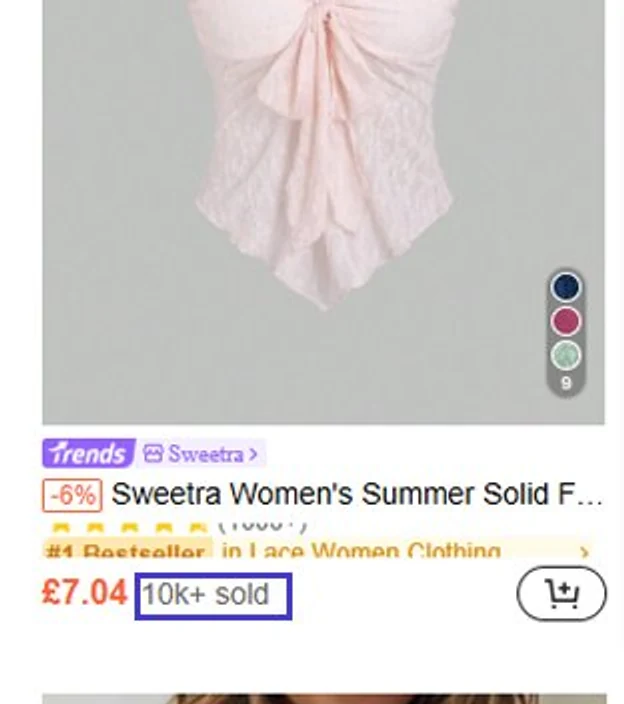
Caption: SHEIN showing both at once: a cumulative "10k+ sold" beside a rank, "#1 Bestseller in Lace Women Clothing". (Screenshot of shein.co.uk, cropped to the claim.)
Live viewers say something the counts cannot
M&S prints "100+ people are looking at this right now". That is not a count of orders and it is not a measure of quality. It is a measure of crowding, and crowding is a different reason to buy — it answers am I the only one here, which a sold count cannot answer.
It is also the signal with the shortest honest shelf life. A viewer count is only true while it is recent, so it has to be read live from traffic rather than computed once a day, and on a store with no traffic it is either absent or a lie. That is the trade: the most immediate of the five signals is also the one that disappears first.
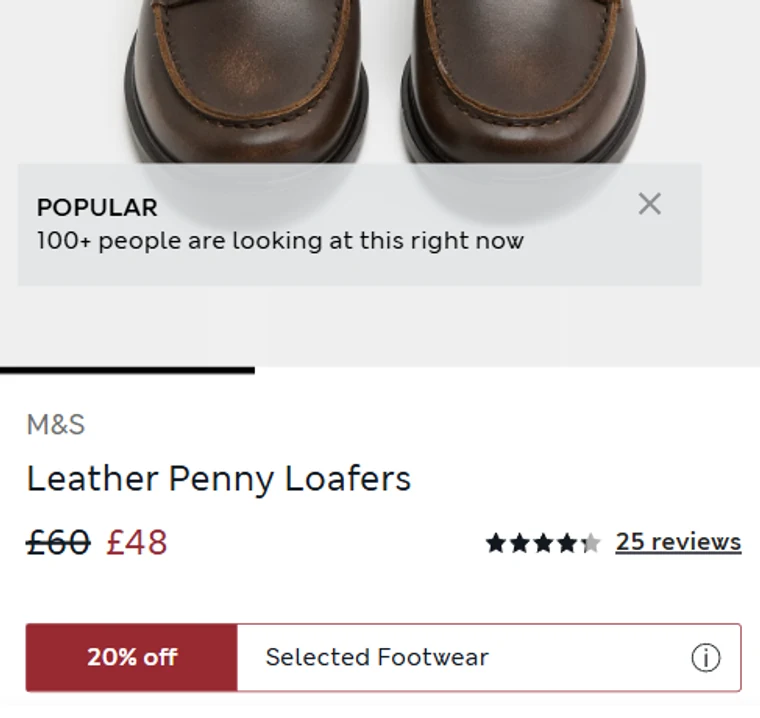
Caption: M&S, on a product page: "POPULAR — 100+ people are looking at this right now". A live reading, not a historical one. (Screenshot of marksandspencer.com, cropped to the claim.)
Two of the six put a rank beside the live signal, which is the other half of the same idea. "Bestseller in Mens Tops" does not tell you the product is good; it tells you it is beating the things around it. Relative proof is the only kind that works in a small catalogue, where an absolute number would be too small to print.
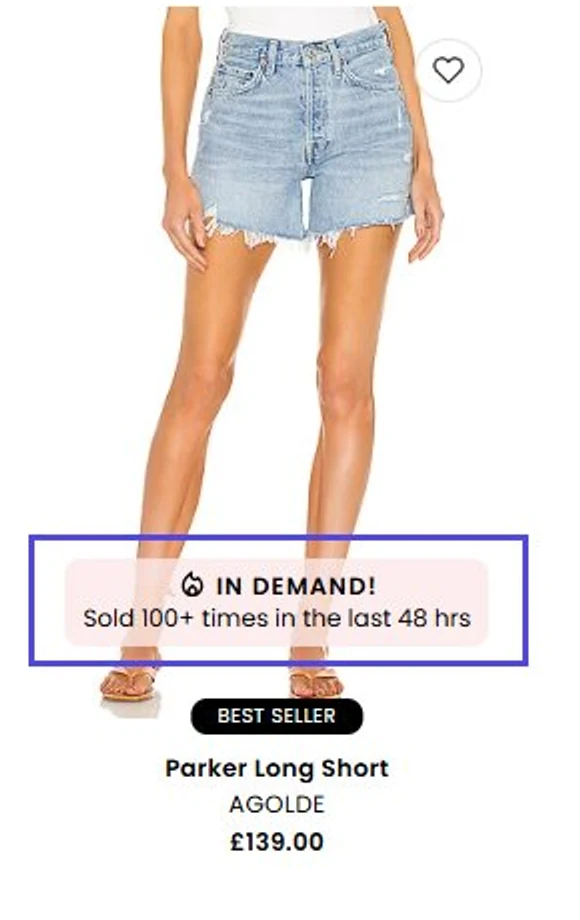
Caption: Revolve stacking two: a 48-hour count and a BEST SELLER badge, on a £139 short. (Screenshot of revolve.com, cropped to the claim.)
And then there is ASOS
"SELLING FAST" is the one claim of the six with no number in it, and it is the one to be careful with.
It might be honest. A store can know a product is selling faster than it expected without publishing the arithmetic, and the phrase does not assert a quantity. But it also cannot be checked, it cannot go down, and it cannot be wrong — which makes it the least useful of the six signals for a shopper and the most useful for a store that would rather not substantiate anything.
Notice which way the direction of travel goes. The stores printing numbers are the ones whose numbers are defensible. A flag with no number sitting next to five counts is not a sixth version of the same thing; it is the category's escape hatch.
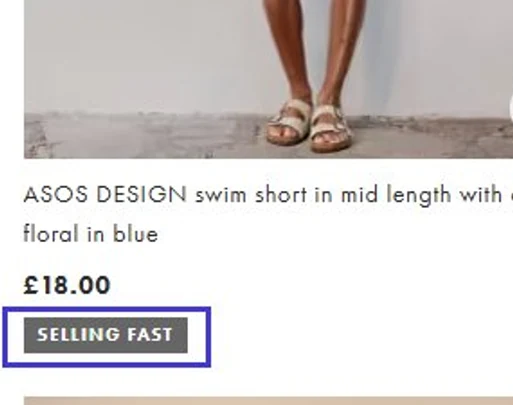
Caption: ASOS: "SELLING FAST", no count, no window, no rank. (Screenshot of asos.com, cropped to the claim.)
What this means for a store your size
You own the same two inputs they do: your orders and your traffic. Nothing in the six examples above needs Amazon's scale, because each one is a count of something you already record.
The differences are which signal you can print honestly. A window count needs enough orders in the window to say something. A rank needs a collection to rank within — and it is the one signal that works when the absolute numbers are small, which is why it is the right first move for a store doing a handful of orders a day. A viewer count needs traffic, and it is the one to leave switched off until you have some.
The rule that carries over from the six examples is the restraint, not the scale. They all print a claim about a population, in small type, with no timer and no invented name. That is available to a store with twenty orders a day. What is not available is printing a hundred when you sold four.
If you want the version of this for a normal-sized store — which numbers are worth showing, where they belong on the page, and the cases where you should show nothing at all — the Q4 walkthrough covers it. And the reverse question, telling real proof from manufactured proof, has its own post here.
Three questions to ask any app
Before you install anything that promises to show proof, ask it three things. The answers are the data model, and a vague answer is the finding.
- Where does the number come from? The right answer names your orders or your live traffic. The wrong answer is a dashboard where you type the number in, or a "social proof" engine that ships with example figures you are meant to edit.
- Can the number go down? A count in a window can, and that is a feature. If every figure in the app only ever rises, you are looking at a cumulative total pretending to be a live one.
- Is it counting orders or estimating visitors? Orders are a fact you own. A visitor estimate is a model, and a model is a claim — which is fine if it is labelled as one, and not fine if it is printed as a count.
An app that can answer all three is telling you how it works, which is the only thing you actually need from it. Two that do: SSM Sold Counter Social Proof reads sold counts, best-seller ranks and live activity from your own orders and traffic, and Judge.me Product Reviews collects the reviews that are the other half of the same argument — one is momentum, the other is evidence.
| App | What it shows | Free plan |
|---|---|---|
| SSM Sold Counter Social Proof | Sold counts in a window, best-seller rank per collection, live cart and visitor activity — all from your own orders and traffic | Yes, up to 10,000 monthly visitors |
| Judge.me Product Reviews | Product reviews, photo reviews and star ratings | Yes, unlimited reviews |
If you want the mechanics of one specific signal first, showing a sales counter without a popup walks through the sold count end to end.
Frequently asked questions
What is the difference between a population claim and a personal claim? A population claim is about a group — "100+ bought in past month" — and a retailer's own order table can substantiate it. A personal claim is about an individual — "Sarah in Edinburgh just bought this" — and nobody can check it. The second is unverifiable by design, which is exactly why it is popular.
Why does an enterprise product page look boring compared with a popup? Because boring survives being asked to prove it. A small number in small type is defensible in front of a regulator, a platform's policy team and a customer who screenshots it. Invented urgency is more eye-catching and has a much shorter life.
Is a lifetime sold count or a count in a window better? A window is more useful today. "Sold 100+ times in the last 48 hrs" says something about demand now; a lifetime total only ever grows, so it eventually stops distinguishing a product that is selling from one that sold once.
Do you need a big store to show this kind of proof? No. The two inputs are your orders and your traffic, which you already have. A store doing twenty orders a day can show a real count in a window; what it cannot do is show a hundred when it sold four.
What should I ask an app before I install it? Where the number comes from, whether it can go down, and whether it is a count of orders or an estimate of visitors. An app that answers all three is showing you its data model, and the ones that cannot answer are the ones to avoid.
Credits and trademarks
M&S, Amazon, Boots, SHEIN, Revolve and ASOS are the trademarks of their respective owners. Each image here is a screenshot of that retailer's own product or category page, cropped tightly to the claim being discussed and to nothing else — a whole-page capture of a signed-in retail session carries that person's delivery details, which is one reason the crop is the evidence and the redaction at once. No store is affiliated with this post, none was asked about it, and no link out to any of them appears here. Their inclusion is comparison, not endorsement in either direction.
Disclosure: we build SSM Sold Counter Social Proof. Judge.me Product Reviews is made by Judge.me; nobody paid for inclusion in this post.
Apps in this post
SSM Sold Counter Social Proof
Real sold counts, best-seller badges and live cart activity.
Judge.me Product Reviews
Collects product reviews, photo reviews and star ratings.
Related reading
- Shopify Social Proof for Q4: Sold Counts and Live Activity
Real sold counts, best-seller badges and live cart activity convince shoppers without inventing urgency — and every number can be traced to your own orders.
- How to Tell Real Social Proof From Fake
Here is the one question that separates them from the ones that measure, and three ways a number can be real and still mislead.
- How to Show a Sales Counter Without a Popup
Social proof does not have to arrive as a corner toast. Here are the three places a sales counter can live on a Shopify page, and how to build each one.