Is a Shopify Mobile App Worth It Before Q4?
A mobile app is one of the most expensive things a Shopify store can add, and it is sold as a growth lever. For some stores it genuinely is one. For plenty of others it is a monthly bill attached to an app nobody opens twice.
This post is about telling those two stores apart. We build SSM Sold Counter Social Proof, so we have a side in this market but not in this category: Shopney is the mobile app builder featured here, it is built by another team, and the honest answer to the title question is sometimes no.
In short: is a Shopify mobile app worth it before Q4?
For a store with repeat customers, yes — a native app buys you push notifications you control, abandoned-cart recovery that does not depend on an ad, in-app campaigns and a faster owned surface. For a store where most customers buy once, usually no: you are paying from $149 a month, with no commission on sales, for a second storefront to maintain for an audience that was never coming back.
Nothing in that answer is about the app being bad. It is about whether the mechanism has anything to work on — because whatever channel brings them back, the offer is what closes, inside the app too.
What does a mobile app give you that mobile web doesn't?
Four things: push notifications you control, abandoned-cart recovery that arrives without an email, in-app campaigns, and a faster owned surface. The speed is real but it is not the reason to do this. The reason is the audience you can reach.
Push notifications you control. An email goes to an inbox you share with everyone else, an ad goes to an auction, and a push notification goes to a lock screen you own. Shopney's listing describes unlimited push notifications as standard rather than metered — and a notification you are rationing is one you stop using.
Abandoned-cart recovery inside the app. On mobile web, a shopper who abandons gets an email, a retargeting ad, or nothing. In a native app the same shopper can be reached where the cart was left — recovery as a message you send rather than a campaign you buy.
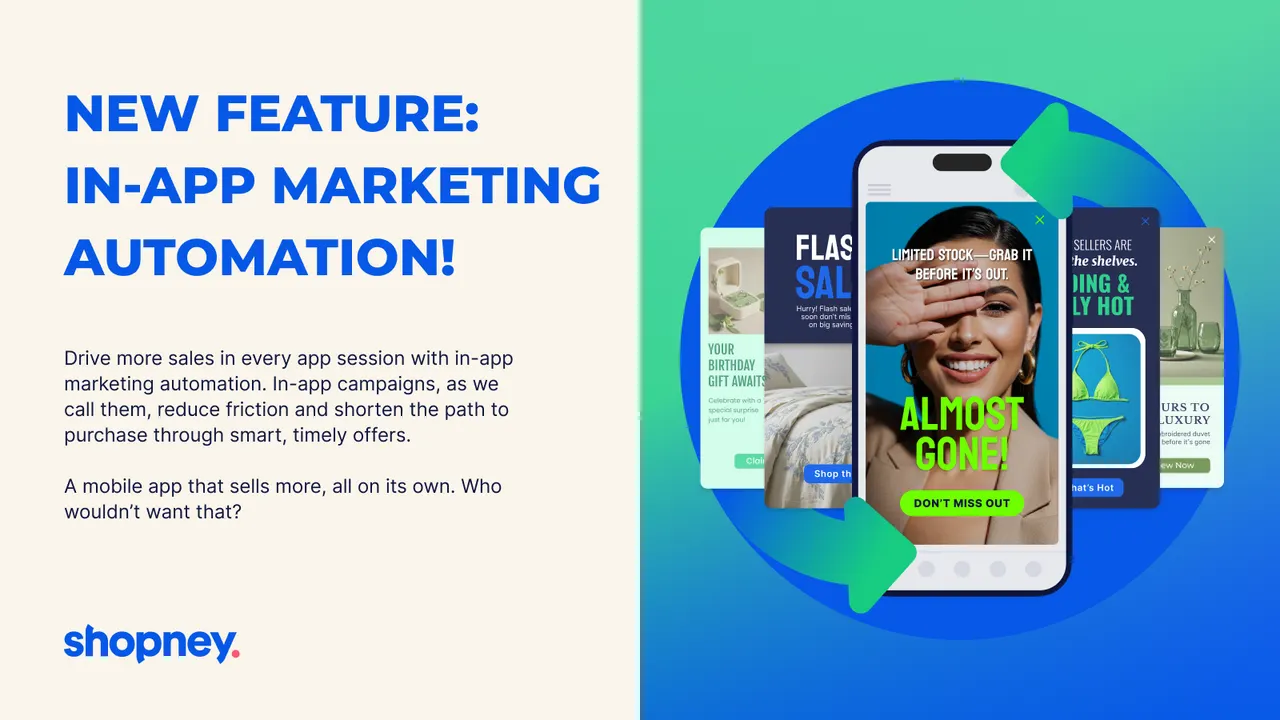
In-app campaigns. Not a banner; a screen state you switch on for a segment — a flash sale for the people who have it open, a birthday offer for the people whose day it is, a limited-stock notice for the people who looked twice.
A faster owned surface. A native app removes the browser from the transaction and much of the third-party page furniture a theme carries. Faster is nice; predictable is better.
The honest limit: none of those things make a stranger choose your store. Every one of them is a reason an existing customer comes back, and if that is not your problem, a mobile app does not solve it.
Who is this actually for — and who should skip it?
The deciding variable is not catalogue size or revenue. It is repeat rate: how often the same person buys from you again. Notifications, campaigns and recovery all need a customer who already knows you, so a repeat-customer store has a channel worth owning and a one-time-purchase store has a download step.
It is for a store like this: a replenishable product — coffee, supplements, skincare, pet food, refills — where the same shopper returns on a predictable cycle. The app lets you reach them when the bag runs out instead of hoping they remember the URL.
It is also for a store with a real community. If a following already asks you for early access or a drops calendar, the app is where those belong. A drops store can push a restock.
And for a store already paying for the problem. If you are running retention ads at people who have already bought, or paying an email platform and still missing your regulars, the app competes with those channels rather than adding another.
Now the harder half. Three kinds of store should skip it this Q4.
- A store built on one-time purchases. Furniture, mattresses, wedding items, one big-ticket product with no repeat cycle. There is no second visit to strengthen, and the app does not create one.
- A store with no plan to use it. An app with no notifications, no campaign calendar and nobody answering the support inbox is a shop window you pay rent on.
- A store deciding this in the middle of Q4. The build is the fast part. Submission, screenshots, review and a test pass are not, and none of that should run while traffic climbs.
There is also a size question worth asking honestly. Shopney's listing carries a claim of 3,000+ brands, which says plenty of small stores use it — but that is their claim, not an audited figure, and it says nothing about how many are still paying a year later.
One more thing to weigh: a native app is a separate property from your Shopify store. The theme, the sections, an app's labels — none of it automatically appears in the app. Ask which parts the builder mirrors and which need rebuilding.
What does launch really involve?
More than the build. Shopney's listing describes AI-assisted app creation without code, and the team says merchants can go live in as little as five days with support through submission and launch. That claim is theirs, it is the best case, and it is about the work before review.
- Build the app. The no-code claim is real for the storefront side: products, collections, cart, checkout and navigation are assembled from your store data. It is not real for everything — a design that departs from the builder's components still needs a developer.
- Submit to two stores. Apple and Google are separate submissions with separate requirements. Both need a developer account, screenshots in specific sizes and a description you write. This is the step that surprises people.
- Pass review. Apple rejects. A rejection is not a failure, but it is a round trip, and each one costs days you may not have.
- Test the actual purchasing path. Install the app on a real phone, add to cart, pay, and check the order lands in Shopify with the right variant, discount and shipping rate.
- Then run it. After launch the work changes rather than ending: notifications on a schedule, campaigns, support, app updates.
- Watch the store rating. Shoppers read app reviews the way they read product reviews, and one bad update can drag the rating down.
The honest limit: the five-day claim is a build claim, not a launch claim. Plan four to six weeks from decision to a live app you are not embarrassed by. Shopney's listing also shows a 5.0 rating from 774 reviews, which is a strong signal about the app and no signal at all about how long your launch will take.
Caption: The three campaign shapes a native app makes possible in one place: a flash sale for everyone with it open, a birthday offer for one segment, a limited-stock notice for the people already interested. Whether you have an audience for all three is the question. (Image: Shopney)
What does it cost?
Shopney starts from $149 per month with a free trial, and it charges zero commission on sales. That is the whole of what it takes from an order: a commission model would quietly turn a growing month into a growing bill. At that price the question is not whether the app is good, it is whether it pays for itself in orders you would not otherwise have had.
Do that arithmetic on your own numbers rather than a published case study, because the published ones are not transferable. Take your average order value, your repeat rate, and how many customers buy more than once a quarter. An app is a fixed monthly cost against a variable return.
The subscription is not the only cost, and pretending otherwise is how this decision goes wrong.
- Developer accounts. Apple and Google both charge for the accounts you publish with.
- Build and design time. The no-code path gets you a working app, not a distinctive one.
- Ongoing hours. Notifications, campaign calendar, support inbox, app updates, review responses.
- The switching cost. Once you have app users, leaving means telling them to go back to the mobile web.
The honest limit: the commitment is not $149. It is $149 a month for as long as you want the channel to exist, plus the launch costs, plus the hours. Before you start, write down who owns the app internally and what they will send in the first month. If that takes more than one sentence, stay on the trial.
How do offers and proof work inside an app?
Exactly as they do on the web, with one change that is easy to miss: inside the app you are not competing with the rest of the internet for attention, only with your own screens. The mechanics are portable; the placement is not, and that changes an offer's economics — not a bigger discount, but a better-timed one.
The clearest example here is Growth Suite, which gives each visitor a personal, time-limited discount code with a countdown and skips the visitors it reads as ready to buy. On the web that is someone who arrives whenever they want. In an app the same code can arrive as a notification.
Offer type decides which surface suits it. A flash sale is a notification, because it depends on people acting in the next few hours. A birthday offer is an in-app campaign, because it is aimed at a segment rather than the whole list. A limited-stock message is both, and it only works when the stock number is real.
The same is true of gamified offers. PieceUp turns a discount popup into a jigsaw the shopper completes for a real single-use Shopify code, with prizes that can be percentage off, amount off, free shipping or a free try again. On the web, the puzzle competes with a browser tab one tap from closing. In an app it sits in a surface the shopper opened on purpose — in-app promotions are a different surface for the same mechanics, and the difference is attention rather than novelty.
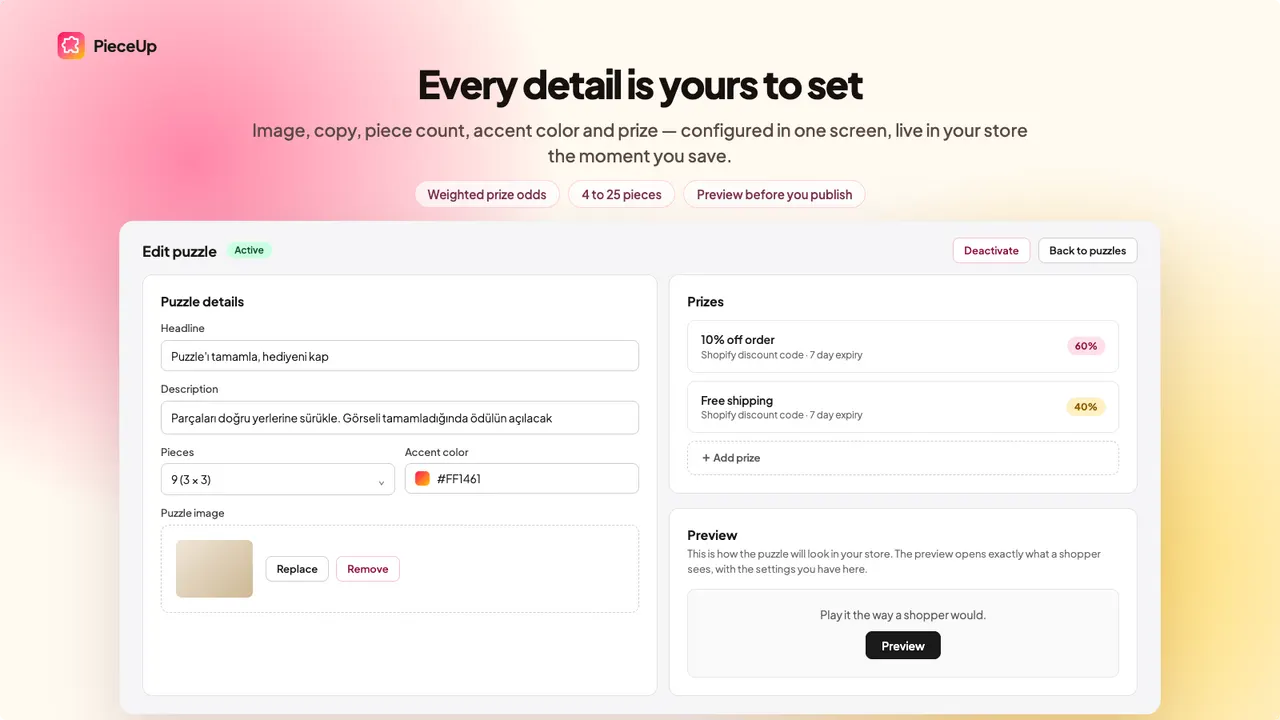
Caption: The offer-building half of the same problem: a puzzle with weighted prizes and one real single-use code per completion. It is the kind of thing an in-app campaign slot suits better than a browser popup, because the shopper is already inside your app. (Image: PieceUp)
Proof travels the same way. A sold count, a best-seller badge or "12 in cart now" is a label on a product image or a line beside Add to cart, and it reads the same inside an app because it comes from the same orders. Our own app, SSM Sold Counter Social Proof, exists for that display, and the rule does not change with the surface: every figure comes from real orders and live traffic. Inside an app the temptation to stretch a number is stronger, because you control the whole screen.
Reviews are the other half of proof, and an app display has one advantage over a product page: no browser chrome around it. Judge.me Product Reviews collects reviews, photo reviews and star ratings, with a free plan for unlimited reviews. A review says this was good; a sold count says this is moving.
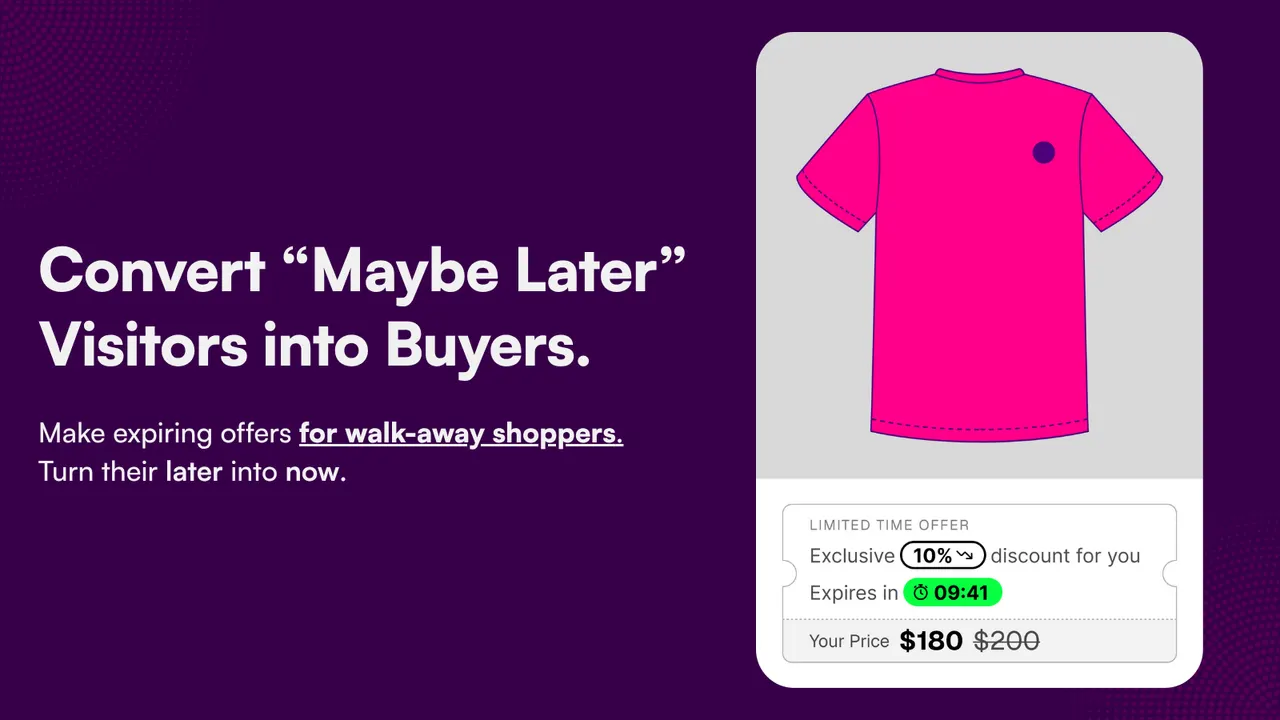
Caption: The offer mechanic that carries into an app unchanged: one visitor, one code, one deadline. What a native app changes is when the message arrives, not what the discount is. (Image: Growth Suite)
If social proof is the part you want to get right first, the Q4 post on sold counts and live activity covers which numbers you can show. And if the products are the problem rather than the surface, showing which units sold on the product page is the smaller fix with the faster return.
| App | Best for | Free plan | Rating |
|---|---|---|---|
| Shopney | Native iOS and Android apps without code | No, from $149/month with a free trial | 5.0 (774) |
| Growth Suite | Personal, time-limited offers for hesitating visitors | No, 14-day trial | Not shown |
| SSM Sold Counter Social Proof | Real sold counts, best-seller badges and live cart activity | Yes, up to 10,000 monthly visitors | 5.0 (1) |
| PieceUp | A gamified discount popup with real single-use codes | Yes | No reviews yet |
| Judge.me Product Reviews | Reviews, photo reviews and star ratings | Yes, unlimited reviews | 5.0 (48,439) |
Where to start
Pull your repeat-purchase rate for the last twelve months before you look at any pricing page. If a meaningful share of your orders come from customers who have bought before, the next step is a trial rather than a decision. If almost all your orders are first orders, put the app on the list for next year and spend Q4 on the storefront you already have.
Frequently asked questions
How much does a Shopify mobile app cost per month? Shopney starts from $149 per month with a free trial and charges zero commission on sales. Budget beyond the subscription: developer accounts with Apple and Google, build and design time, and somebody's hours every month for campaigns, updates and support.
Is a mobile app worth it for customer retention? Only if you have customers to retain. A store whose shoppers return every few weeks gives the app something to send — a restock, early access, a birthday offer. On one-time purchases the app adds a download step to a journey that was already over.
Do I need a mobile app before Q4? That depends on the date. Plan four to six weeks even when the build takes five days, because submission, screenshots, review and testing sit between you and a live app. If peak season has already started, the honest answer is no.
What happens to my app if I stop paying? You lose the app, and the audience inside it. The install base is only as durable as your plan. That is the real commitment here: not one month of $149, but every month after it.
Credits and trademarks
Shopney is built by Shopney, the company of the same name; we do not make it and we are not affiliated with it. Its visual is a promotional image from that app's own Shopify App Store listing, used to illustrate what the app does and credited to its owner beside the image. Growth Suite is built by Growth Suite, PieceUp is built by PieceUp, and Judge.me Product Reviews is built by Judge.me — we do not make any of them either, and their visuals are promotional images from their own listings, credited the same way. SSM Sold Counter Social Proof is the only app here that we build. None of these images is a screenshot of a customer's store, and inclusion is not an endorsement by any of these companies of anything we build.
Shopify and Shopify Plus are trademarks of Shopify Inc. Apple and the App Store are trademarks of Apple Inc. Google and Google Play are trademarks of Google LLC. All other product names, logos and brands are the property of their respective owners and are used for identification only. Ratings and review counts were read from the App Store listings on 13 October 2026 and change over time.
Disclosure: we build SSM Sold Counter Social Proof, which appears in the comparison table above. Every other app in this post is made by a different team, none of them paid for inclusion, and this post is part of a Q4 series written with the teams behind those apps.
Apps in this post
Shopney
No-code native iOS and Android apps for Shopify stores.
Growth Suite
Personalised, time-limited offers for shoppers who hesitate.
SSM Sold Counter Social Proof
Real sold counts, best-seller badges and live cart activity.
PieceUp
A jigsaw discount popup that mints a real single-use Shopify code.
Judge.me Product Reviews
Collects product reviews, photo reviews and star ratings.
Related reading
- Shopify Social Proof for Q4: Sold Counts and Live Activity
Real sold counts, best-seller badges and live cart activity convince shoppers without inventing urgency — and every number can be traced to your own orders.
- How to Show Units Sold on a Shopify Product Page
Shopify has no built-in way to display units sold on a product page. Here are the three ways to do it, what each one costs, and when each one breaks.
- Shopify Discount Popups: Gamified vs Plain Compared
A plain discount popup hands 10% to anyone who scrolls past. A jigsaw asks for thirty seconds and gives the code to someone who just looked at your product.